Ah, now I wish I had never brought up those verhovens, bad trashy movies, which just make people go nuts. 
2 Likes
I promise never to bring up Jess Franco in conversation then. I don’t want anyone to develop and strange practices.
1 Like
3 Likes
Starship Troopers 1997
Another Verhoven’s movie which spawned quite a few sequels of disputable quality - if you have seen ST 3 Marauder with Casper reprising his role you know what i’m talking about.
I didn’t read Heinlein’s novel, which is weird since 80% of books I read is sf, but i guess I never was into military sf. That said this might be the finest military sf movie, but competition is not very harsh - I mean there’s Aliens and Wing Commander. Solid 8/10, but I’d say my least favorite of the sf trio I watched.
3 Likes
Once Upon a Time …in Hollywood. For the 7th time. Brilliant
2 Likes

Rebel without a Cause (1955, Nicholas Ray)
The movie that turned 24 year old James Dean into one of the most important icons of the 20th Century, alongside Elvis and Marilyn Monroe. I guess most people will be familiar with the story about three younger people – played by Dean, Natalie Wood and Sal Mineo – standing up against their parents, with tragic results. Some elements are dated, and Dean’s acting is marked by mannerisms (most of them copied from Brando), but it’s easy to see why the film had such an incredible impact: it inspired an entire generation of bewildered young people who felt deeply dissatisfied with society and the life their conformist parents had planned for them.
The film was shot in the recently introduced ultra-wide (2,55:1) Cinerama format; many directors felt uneasy with the format and mainly used it for panoramic shots, but Nic Ray and his cinematographer Ernest Haller use the widescreen to perfection, both during the indoor and outdoor scenes, with some daring camera movements perfectly underlining the disarray of the situation. The movie brought Dean eternal fame, but no luck: he crashed his Porsche only days before the movie’s premiere. Wood and Mineo did not fare any better: Wood (she was 17 when the film was made) died under mysterious circumstances during the making of another movie and Sal Mineo (only 16 at the time) was stabbed to death by a street thug who didn’t know who he was.
**** out of 5
3 Likes
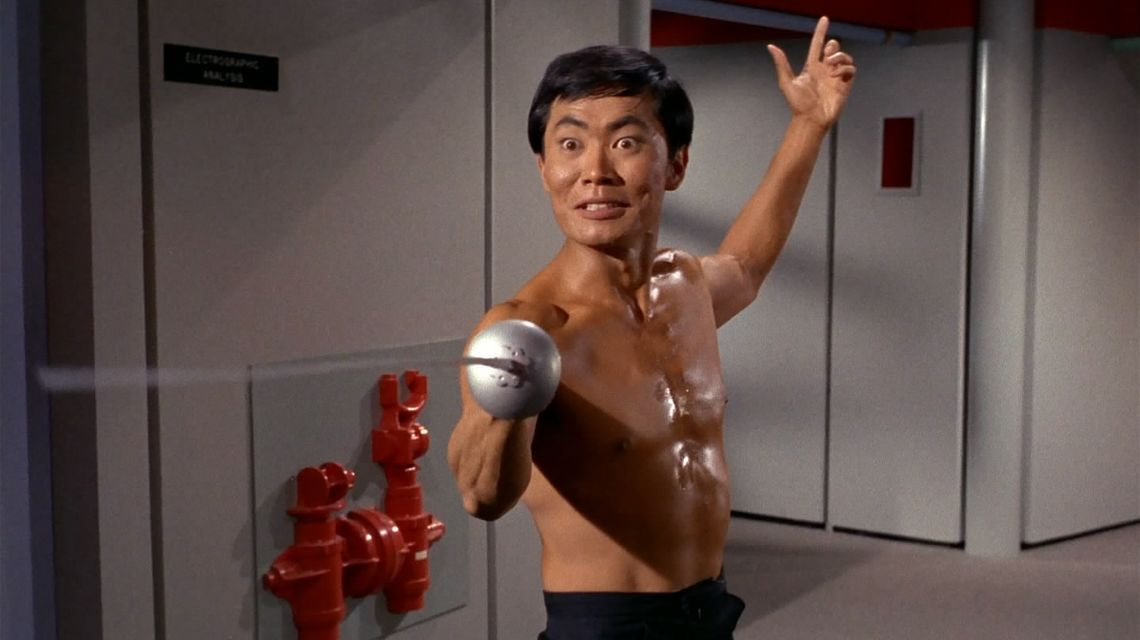
Maybe Asa meant you are ripped like Sulu.
If only
Just watched a German actioner called Zabou AKA The Crack Connection (1987) starring Götz George. Not a great film but definitely enjoyable. I’d love to check out the TV series that it was based on but I’m not a German speaker. The version of the film I watched was dubbed into English, which wasn’t too bad. It reminded me of the kind of dub you’d hear in an Italian film from that period.
2 Likes
One Year in a Life of Crime (1989) (Doc) - Director: Jon Alpert - 7/10.
Body Shot (1994) - Director: Dimitri Logothetis - 3/10 - The biggest issue with the whole enchilada is that it doesn’t really know where it wants to go both stylistically and storywise. The storyline essentially vacillates between the usual kind of 1990s trashy neonoir, which I happen to cherish quite a lot, and something more along the lines of the Jag Mundhra’s DTV skin flicks. While this combination tends to bubble up in later genre examples with varying degrees of success, the thing is that it doesn’t really work here at all and both components never really coalesce into one stylistically coherent whole; the miserable tout ensemble eventually ends up feeling more like a glorified skin flick that’s not explicit enough to gratify wankers, but explicit enough to become genuinely distracting and annoying. What’s worse, the story itself verges on pure absurdity, resorting to all kinds of absurdly over-the-top twists and revelling in its unabashedly manipulative writing choices. In its poor attempt at imparting a certain dose of refinement to the whole package, the narrative even goes so far as to provide some supplementary voice-over, which doesn’t fit at all and only adds to the stylistic confusion. Although the stylization and the overall vibe of the narration seem to be right up my alley at first glance, most of that simply rings hollow, whereas the kitschy visual presentation clearly attests to salient unimaginativeness of the creative forces behind the camera.
Bodily Harm (1995) - Director: James Lemmo - 3/10 - It’s yet another film with the female protagonist falling for a guy who might be the serial killer on the loose. The whole concept might not be all that intrinsically paltry, however, the execution of the material here happens to be on the flimsy side and constitutes the determinant that completely debilitates the composition beyond repair. The apathetic pacing accompanied by laughably transparent red herrings effectively renders the work completely stagnant and makes it mind-numbing to watch. Oddly enough, the cast features some fairly illustrious names such as Linda Fiorentino, Daniel Baldwin and Gregg Henry, but their participation in the project appears to have been driven by purely fiscal motives as opposed to any real interest in the work; suffice to say, all aforementioned actors drift through consecutive phases of the script without much involvement and often seem to utter their lines in a distinctly detached, impassive, quasi-catatonic manner. Last but not least, all of it is topped off with a remarkably pedestrian, almost anti-climatic resolution. I’m really beginning to scrape the bottom of the barrel here, I should probably move on to another niche instead of tormenting myself like this.
Sharky’s Machine (1981) - Director: Burt Reynolds - 7/10 - However hackneyed the overall outline of the story may seem, the fact of the matter is that film’s robust characterization, well-delineated interpersonal dynamics as well as balanced pacing make up for movie’s admittedly threadbare core of the storyline. Moreover, Reynolds gives probably one of the most memorable performances in the history of his career; that is not to say his persona is anything out of the ordinary here, but I guess it’s reasonable to say his usual screen charisma is coupled with the inner workings of the tale in a very dexterous manner, making it all a genuine pleasure to view. Reynolds also endeavors to diversify the whole tough cop trope with some more endearing moments, which are probably intended to provide the protagonist with some depth; while these emotional sequences are quite welcome and furnish the entire effort with an extra level of poignancy, these auxiliary scenes never seem to make a lasting impact and ultimately feel rather inessential. Even though the resolution may seem somewhat rushed as well as slightly clunky in comparison with the rest of the motion picture, it proves quite adequate and functional. Definitely the better of the two Reynolds-directed crime flicks from the 1980s.
Digital Man (1995) - Director: Phillip J. Roth - 5/10 - Not exactly a particularly cerebral experience so to speak, but its trashy irreverence as well as its surprisingly taut composition make it entirely satisfactory in the modest B-movie sense. Despite bifurcating and trifurcating at various points, the narrative doesn’t really feel all that out of focus and proves to be astonishingly engaging irrespective of some obvious flaws. Needless to say, there are things that alternately work and don’t work here, but overall, the final total turns out to be in the black. Most probably, the most glaring fault is its excessive reliance on juvenile redneck/white trash humor, which essentially boils down to making fun of the flyover America in a ham-fisted manner, but these moments only intermittently surface and never grow prominent enough to become genuinely irritating. I wouldn’t say the motion picture is marked by any striking premeditation or any compelling creative sensibilities; I guess it’s fair to say the makers of this flick probably threw everything against the wall in the hope that some of it would stick and they basically succeeded in the process. Digital Man is ridiculously rife with action, explosions, asinine wisecracks and devil-may-care early CGI FX and while the whole combination might not sound all that absorbing, the way all of the aforementioned constituents blend together makes it all surprisingly enjoyable in the end. It’s a piece of shit, but it’s the kind of shit that’s kind of fun to watch.
Android (1982) - Director: Aaron Lipstadt - 6/10 - Initially, I thought it would turn into Kinski and his android trying to outcreep each other, but there is a lot more to it than that. The film raises all sorts of questions with regard to the nature of humanity and the moral ambiguity surrounding the creation of androids with human sensibilities and it does so with a strain of quirkiness as well as an oddball sense of humor rarely found in other ventures of this sort. There is no disguising the fact the whole project was made on a shoestring budget, but the way in which the movie accentuates its core theme largely circumvents its budgetary constraints and that enables the endeavor to recount its eccentric story in a fairly engaging manner in the teeth of the aforesaid limitations. I wouldn’t say I found this peculiar outing to be all that compelling, but I’ve got to admit that it was quite prepossessing in its singularly quaint depiction of the general topic; it’s definitely worth a look, as it’s probably one of the most unorthodox sci-fi pictures out there and it stands out from the crowd by virtue of being something quite different.
Contamination (1980) - Director: Luigi Cozzi - 3/10 - While the flick is kind of enjoyable in the first part, in which the action is set in the city, the instant we leave the urban area things start to fall apart very quickly. The biggest issue with the endeavor is that Luigi Cozzi isn’t much of a director and his creative deficiency manifests itself in atrociously cut action sequences as well as some fairly heinous montage. Although the former half of the work is narrated in a moderately balanced manner as I’ve already mentioned, the movie rapidly begins to deteriorate towards the end with key scenes being intercut with shots of genuinely trifling importance and film’s editing being on the kooky side, all of which renders the second half ridiculously arrhythmical as well as remarkably tedious. Virtually all sequences either last for far too long or are simply too short and this narrative chaos especially peaks during the denouement, which comes to be completely stifled and crippled by virtue of this complete editing idiocy. Flick’s only de facto asset is Goblin’s engrossing soundtrack, which makes all of it a lot less painful than it would normally be. All in all, it’s not something I’ll be rushing to re-watch any time soon.
Virus (1980) - Director: Bruno Mattei - 3/10 - While we’re on the subject of Goblin’s great work on Contamination, why not also watch Mattei’s Virus from 1980 which happens to feature the exact same score? Well, although I do prefer it to Contamination, the most infuriating element here turns out to be its overreliance on stock footage, which sometimes feels like it fills half of the running time and practically fails to contribute anything substantive to the plot. This ubiquity of the completely gratuitous filler makes it all very distracting and often necessitates the fast-forward button routine. The moment the film desists from this stock footage nonsense, which is towards the end, also marks the point at which the venture becomes slightly more entertaining and less hectic in its narrative focus. I can kind of see the trashy appeal of the work, but I’ve got to say I just failed to connect with it on any meaningful level because of the pervasiveness of unnecessary stock footage inserts. With all that being said, it’s still preferable to Contamination in that it’s a lot more fun to watch.
Twin Sisters (1992) - Director: Tom Berry - 4/10 - A fairly standard DTV thriller with the twin switch shtick thrown in to make it look slightly less cliched than it already is. The issue dwells in the fact that the story is unfolded in a mind-numbingly pedestrian fashion practically without leaving anything to the viewer’s imagination until the very resolution, which admittedly features a moderately surprising twist. Another problem with the venture is that Stephanie Kramer isn’t that strong of an actress to carry out her role in a convincing fashion and she is primarily in there to “look good and cute”; consequently, her performance proves to be remarkably unremarkable and never really adds anything of worth to the tout ensemble, which is something that also reflects the acting featurelessness exhibited by the rest of the cast. Overall, while it would be unfair to say the motion picture constitutes a train wreck or some vexing travesty, the whole work just never manages to rise above its firmly formulaic, humdrum status, remaining just okay and passable most of the time without really excelling in any particular field in the end.
Running Scared (1986) - Director: Peter Hyams - 7/10 - Normally, a movie like this shouldn’t work as well as it does here, but thanks to Hyams’s incredibly galvanizing directing as well as Hines’s and Crystal’s performances, this otherwise standard material instantaneously gets catapulted into pure comedic resplendence. Gregory Hines and Billy Crystal succeed in creating some excellent chemistry which manifests itself in their excellent rendition of exceedingly witty, funny dialogues, pert quips and in the overall incessant on-screen merriment. Admittedly, film’s narrative gets somewhat out-of-focus and choppy in the second half, but astonishingly enough, the Hines-Crystal pairing is so strong and Hyams’s direction so unusually resolute and energizing that the destructive effect of the jerky pacing gets completely overridden by the aforementioned elements; this is something that makes Running Scared a uniquely thrilling, but also somewhat hectic ride. As much as I enjoyed the entire offering, there is no denying the fact that it’s not one of the most balanced buddy cop films out there, it sure as hell is one of the most enjoyable ones though.
Tinker Tailor Soldier Spy (2011) - Director: Tomas Alfredson - 9/10 -> 8/10 - A re-watch.
The Killings at Outpost Zeta (1980) - Directors: Robert Emenegger, Allan Sandler - 5/10 - Bedraggled costumes and tawdry props clearly attest to film’s shoestring budget, however, the whole project manages to surmount some of its technical shortcomings by furnishing adequately gritty production aesthetics in the form of surprisingly effective filter effects, artificial mist and grungy POV shots, which endow the entire work with an uncannily frenetic and tense atmosphere. There is no disguising the fact that the motion picture greatly suffers from its meager budget readily apparent in its derelict sets, notwithstanding, the aforementioned grittiness in conjunction with its moderately engrossing reformulation of the Alien premise as well as the underlying brutality of the plot makes it sort of dark and charming in a low-budget sort of way. Additionally, it gains some momentum towards the end and proves to be quite taut and suspenseful in the course of its resolution. There is no denying the fact that it’s a fairly uneven, erratic as well as intermittently stagnant effort, which is something clearly reminiscent of other cheapos of this kind, nevertheless, there is likewise a certain sense of creepiness, which is very evocative of low-resolution video games and weird, unsettling C-grade filmmaking of dubious origins, and that’s the element that makes this singular cheapo combination quite unique and prepossessing in its own right.
The Secret of Oz (2009) (Doc) - Director: William T. Still - 7/10.
12 Angry Men (1957) - Director: Sidney Lumet - 10/10 = 10/10 - A re-watch.
Legal Eagles (1986) - Director: Ivan Reitman - 5/10 - The primary issue with the movie lies in the fact that film’s biggest asset, which are Redford’s and Winger’s performances as well as the great chemistry between the two, takes a backseat to the gratuitously convoluted central mystery, which isn’t all that absorbing or interesting to begin with. The writing frequently feels pretty overworked, labored and ponderous which makes itself patently obvious in the way the narrative seemingly doesn’t know where to go or how to present its tale in a more engaging manner, progressing from one scripting phase to another in a rather cumbersome fashion. The whole story appears to be overpacked with ideas and a lot of these unfortunately happen to be on the pedestrian side and don’t really contribute all that much to the overarching plot or the central relationship. Hence, as enjoyable as the performances by Winger and Redford are, there is no disguising the fact that they regrettably feel like an expendable appendage to the fairly humdrum story.
Life of Crime 2 (1998) (Doc) - Director: Jon Alpert - 6/10.
The Drifter (1988) - Director: Larry Brand - 6/10 - Although it’s hard to deny film’s rather poor production values, some unnecessary bloopers (take that fucking boom mike out of the frame for pete’s sake, goddamn it) or that the whole story eventually gets wrapped up in too convenient a manner, most of these shortcomings are rendered negligible in light of this flick’s taut narrative, excellent pacing, some decent lighting, fairly compelling performances given by the main cast, quite tense atmosphere as well as overall grittiness of the central story, which is further bolstered by some pretty goddamn tasty and grungy-sounding low resolution string drones found in the soundtrack. The motion picture is a perfect example of a great trashy neonoir before the genre deteriorated into a softcore porno subgenre of sorts. It looks and sounds exactly the way I want my DTV garbage to be: gritty, dark and suspenseful. Likewise, it features one of the nastiest monologues ever delivered by a film villain, I mean it’s comically dark and gruesome and further adds to the enjoyment. I guess it all depends on what you’re looking for, but to my way of thinking, it ticked all the boxes as far as the trashy neonoir stuff goes and proved to be exceedingly enjoyable in the end. A very gratifying, scrumptious piece of junk, just the way I like it.
Playmaker (1994) - Director: Yuri Zeltser - 5/10 - The glamor of the luxurious LA estate as well as the initial eeriness of the plot are somewhat reminiscent of the David Lynch movie; film’s failure to live up to its lofty potential kind of makes it a striking outing in the sense that it makes one ponder more on what all of it could’ve been with the right person at the helm rather than what it ultimately turns out to be. I guess the flick is worth checking out purely because of its unusual and confusing beginning; the biggest fault of the motion picture indubitably lies in the fact that the instant it sheds its misleadingly sophisticated aesthetics it opts for the most mind-numblingly mediocre and crude resolution, thereby stripping its tale of the mysteriousness that made it so appealing in the first place. Hence, instead of continuing in this more ambiguous and slightly disturbing tone, which is apparent in the former part of the story, and offering us a bit more novelty, it just devolves into this derivative, piffling tripe. I guess it is still highly watchable by virtue of decent performances given by Colin Firth and Jennifer Rubin, but there is no disguising the fact that the flick completely loses its impetus after the first half, whereupon it proceeds to stumble towards the end in a rather cumbersome fashion. I really love the closing scene (I wish the entire endeavor was more along those lines instead of this stylistically incoherent, crude mess), the overall concept as well as the lush soundtrack, but that’s about it.
La casa con la scala nel buio (1983) - Director: Lamberto Bava - 4/10 - The issue with Lamberto Bava’s direction dwells in the fact that he really struggles to establish a sense of time and place as well as to develop the characterization properly. Boundaries between consecutive phases of the script feel somewhat blurred in the sense that the narrative merely seems to be wandering around without much sense or purpose, whereas the identity of the killer becomes salient virtually from the very get-go, which further robs the plot of any semblance of suspense. What is worse, the narration rarely leaves the premises of the modernist residence, where the majority of action takes place; this is something that imbues the flick with an oppressively claustrophobic atmosphere and while this could’ve been exploited to compound dread and tension, you simply cannot compound something that isn’t there to begin with; the fact of the matter is that the laggard pacing makes the tout ensemble a rather somnolent experience indeed. Other than some Revox tape machines lying around and some jaunty electronic riffs courtesy of De Angelis brothers, the movie is simply too infused with stifling tedium to my liking and I found little of it to be much of interest.
Quake (1992) - Director: Louis Morneau - 4/10 - A standard TV fare about a stalker who kidnaps and imprisons his neighbor during a cataclysmic earthquake. Apart from Railsback’s dedicated performance, there is very little out of the ordinary here and most of the narrative occupies itself with immediate story progression i.e. the female protagonist desperately endeavoring to break free all the while her partner is attempting to get back and ensure her safety. Despite its short running time as well as ostensibly being packed with action, the motion picture feels rather slow and protracted on account of the dearth of novel ideas and the general repetitiveness of consecutive scenes; there is no real characterization and very little exposition to provide some extra depth to the whole enchilada, which is why the narration appears rather cursory and most of it essentially boils down to the stalker throwing tantrums and being creepy towards the woman while her consort tracks both of them down. The movie stays just barely coherent to make some sense in the end, but it’s far-fetched enough to raise a few eyebrows. Overall, quite forgettable and the only real reason why this still somehow manages to be watchable in spite of its numerous flaws is the creepy acting by Railsback.
When a Stranger Calls Back (1993) - Director: Fred Walton - 8/10 - The TV production is quite remarkable in the sense that its lighting and impressive cinematography are way more cinematic and elaborate than most television works of this kind out there. As a matter of fact, Walton’s firm control over the narrative, the steady pacing as well as the sparseness of its central story endow the entire endeavor with an uncannily modern indie feel in the likes of The Babadook and so forth, except that it’s much more outlandish and creepy than that. Surprisingly enough, the work doesn’t become pretentious and continually builds up its tension in a systematic and tasteful manner. While the opening half an hour is certainly the best part of the film in that it exhibits Walton’s unusual knack for developing suspense in an adept way without relying on any inept jump scares, the rest of the tale is likewise executed with prodigious elegance and restrainedness. Admittedly, some people may take issue with some logic gaps as well as some loose ends left in the plot, but none of that really matters all that much to me inasmuch as the motion picture displays a conspicuous degree of supernaturalism, which altered my expectations accordingly and made me cherish the viscerally sinister feel of the narration instead; in other words, the whodunit element of the story isn’t as significant as the baneful atmosphere and the overall aesthetics.
Ground Zero (1987) - Directors: Bruce Myles, Michael Pattinson - 6/10 - While it’s hard to deny the overall sturdy execution and good performances given by its main actors, the primary issue dwells in the fact that it retreads pretty much the same ground as other conspiracy thrillers out there, except that it is also duly adjusted to the Aussie context to make it seem more novel than it really is. Secondly, although the main topic may appear noble in principle, it feels as though almost all Aussie flicks bore upon the exploitation of the Aborigines in one way or another, which makes it rather derivative and predictable in the grand scheme of things. The subject of nuclear testing on the Australian soil back in the 1950s gives it a unique spin, nonetheless, the way the motion picture slavishly progresses from point A to point B according to the all too familiar formula marks a certain stylistic as well as conceptual deficiency at the core of its story and attests to the firmly formulaic nature the film regrettably exhibits throughout its running time. That is not necessarily to say the flick isn’t enjoyable to watch, but I think it could’ve been a lot better all things considered.
2 Likes
Where the fuck is Robocop 3? 
1 Like
Haven’t gotten around to it yet, I will probably view it alongside the second installment of the series. It sometimes feels like it’s the movies that pick me rather than the other way round, so I can’t say for sure when I’ll watch it. So much other junk to see in the meantime.
2 Likes
Don’t we all?
I expect full report in 24 hours.
1 Like
Robocop 3
I watched Barcelona - Bayern instead: 2/8
It’s got its moments, it’s pretty fuckawful though. Over and out.
1 Like
I’m actually surprised that you really watched it. 
1 Like
Well, I thought you would keep bringing it up and besides, I was kind of intrigued. Now that I’ve seen it, I think I’ll stay away from Robocop movies for the time being, thank you very much. 
1 Like
Me? Never.
1 Like