“hell” is primarily the US release title, is that correct?
I believe so … but it wasn’t released there first, nor is it an American film … as it says on wikipedia the name was changed for release in America, because the word ‘bastard’ was seen as offensive … but as this is a British / Spanish co-production the original name should be listed first.
In that case I agree we should list it with it’s Bastardy title and I shall implement that later
2 Likes
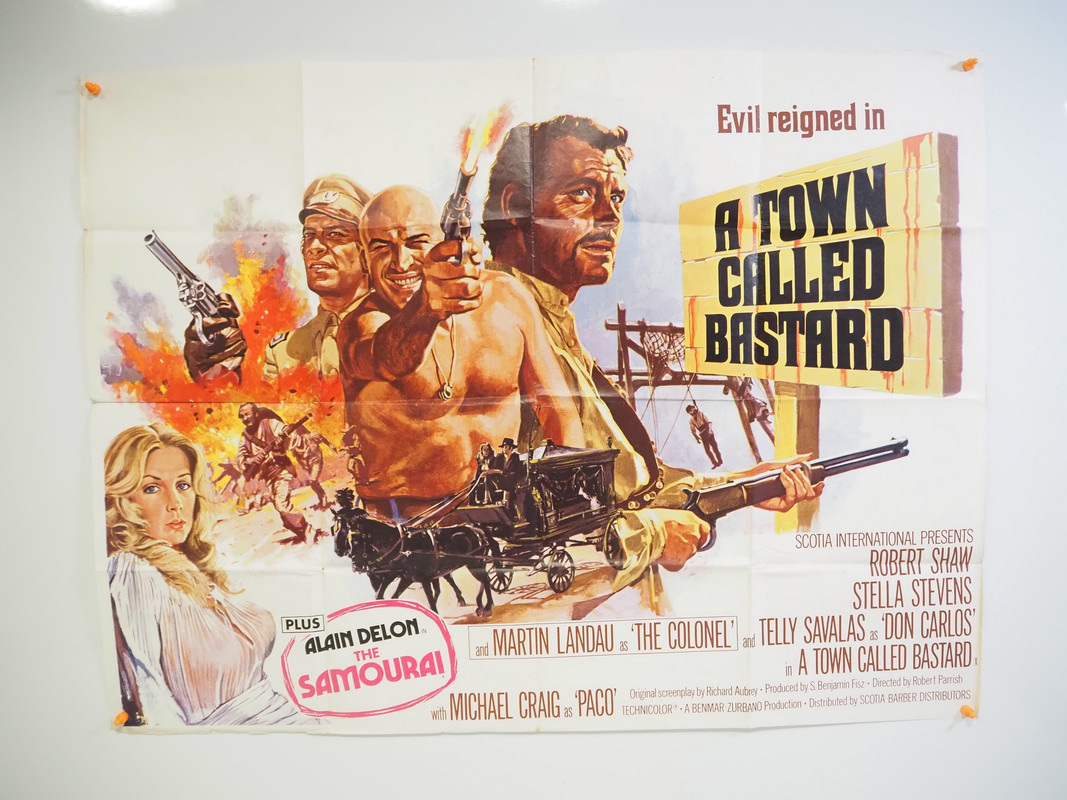
… interesting to see this one at it’s time of release with ‘The Samourai’ playing as 2nd feature … probably an English dubbed version, but ‘A Town Called Bastard’ is now a forgotten movie for many and ‘Le Samourai’ is considered a masterpiece.
2 Likes
Which is very very reasonable for both.
1 Like
Are we in agreement for once!
That’s the reason I made the point about this strange coupling of movies - Distributors must have been very shortsighted to put these two together, especially in that order … but at this time very few French movies would be shown in Britain outside of a tiny number of ‘arthouse’ cinemas … so for ‘Le Samourai’ to be part of a mainstream release was quite unusual.
Mainland Europe were and are much more inclusive about the films they show, I suppose because they would be dubbed.
The only other non UK and USA films released at this time approximately would be ‘The Burglars’, ‘The Sicilian Clan’ and ‘The Legend of Frenchie King’ … but these were all made in two versions, for the French speaking audience and the English speaking International market .
1 Like
I wrote about this in a review of the German BluRay if Burglars once. Fascinating tactics then to just film everything twice instead of once and dubbing
2 Likes
Yes … but much more expensive - However, these films mentioned were backed by distribution deals with major film companies - Columbia for ‘The Burglars’, Twentieth Century Fox for ‘The Sicilian Clan’, Hemdale (who no longer exist) for ‘Frenchie King’ … also, Paramount, ‘The Brain’ / Le Cerveau (1969) with JP Belmondo, David Niven, Eli Wallach etc also filmed in 2 versions … The advantage is that the original actors dub their own voices, although Lino Ventura in 'The Sicilian Clan was redubbed by a voice actor even though he is speaking English dialogue … too thick an accent perhaps.
Some very spaghetti-esque images in this one, but apart from this a not very engaging film.
The flashback scene felt weird.
Not sure about Robert Shaw and Martin Landau in a spaghetti western, but maybe that’s just me?
Richard Gordon’s autobiography confirms Michael Craig’s memoirs in saying that all of Craig’s scenes were shot about two months after the end of principal photography because the first cut of the movie didn’t make sense. Shaw was rehired for those scenes and looks quite a bit different (now clean shaven). I am not sure Craig’s scenes help much with that either. Gordon wasn’t involved with the original shoot but helped out with the reshoots- Irving Lerner filmed some of them (I think Parrish wasn’t available for the reshoots). Filming began in July 1970.
The producer, Ben Fisz, ran a UK company Brenmar which got its capital from a leisure group. Fisz sorted out the UK funding for Philip Yordan. Fisz also commissioned the screenplay which Yordan was supposed to rewrite. Yordan’s team constructed their own set of the ‘Bastardo’ town for the movie and reused it in Captain Apache and Bad Man’s River.
I hadn’t seen this for a while. Visuals are appropriately grubby and Parrish uses a lot of Leone-style close-ups. The script is a mess though and it does look like, as at least one poster claims earlier, that many of the name actors were only hired for a week or so so they could be had cheaper so then written out of the film. Shaw had worked for both Yordan and Fisz before. I don’t know what Stella Stevens was doing in this though as all her other films are American. However, she isn’t in a lot of scenes - disappearing quite a bit - so possibly she was only there a week or two as well. Not sure why they paid for Landsu and Lettieri to fly over as they weren’t big names and they had others already based in Europe. I thought the Craig scenes were too long and this was a jarring intrusion at so late a time. Action scenes were quite choppy and poorly choreographed and Ray as the blind bloke looked ridiculous. I wasn’t sure who Dudley Sutton was supposed to be - he’s called ‘Spectre’ in credits but not referred by any name in the movie. Is he Death, a Guardian Angel or something else?
1 Like
There is not one word of this film in Parrish’s autobiography.
As I stated earlier, despite the narrative structural flaws, there is a lot to recommend here; a bizarrely gothic atmosphere, a genuine spaghetti aesthetic, good performances, and an intelligent script by Richard Aubrey, which is about morality. The film seems to be making the point that even if you were to do the right thing, there still is no satisfaction in this. It exerts a strange fascination.
The Kino Lorber Blu-ray is a poor release, full of ghosting, artefacts and audio dropouts.
1 Like
The audit on the You Tube version I watched wasn’t too good aurally either, It was especially difficult to understand some of Landau’s dialogue when he was talking to Shaw and Shaw’s unnecessary Irish accent attempt didn’t help either. I suspect the audio problems are endemic to the post recording process.
This film used to play quite a lot on UK TV channel ITV. It is a British-co production after all. The UK censor cut the beating-up of Paco for an X (over 18) rating and these cuts still seem to be present (censor’s note refers to cutting of the kicks and there are none in the print and a couple of obvious edits in the scene).
Directors can be ‘funny’ about films that haven’t turned out well in their eyes. I imagine Parrish was annoyed by the reshoots which were done without him and his knowledge per Gordon’s book. They take up about 20m of the movie. Irving Lerner directed the reshoots or at least most of them; to film the disorienting effect of Paco staggering around the saloon they had a cameraman in a wheelchair!
On a similar note, not western, but William Castle’s autobiography completely omits his movie The Old Dark House for reasons unclear.
The novelisation really goes to town on the character of Spectre, Alvira’s bodyguard - he is a deaf mute who looks like a living skeleton, dresses like an undertaker, and backs up his shotgun with “two large, odd-looking Derringer pistols” like Sabata or Sartana.
1 Like
He talks to Stella Stevens when she is lying in the coffin just after the opening credits says ‘Wake up, we’re almost there. Whatever happens, do as I tell you’.
So he isn’t a deaf mute although she tells Don Carlos he is a bit later.
The conversation he has with her isn’t consistent with the rest of the movie.