I just watched Alex Cox’s “Highway Patrolman” on the Kino Lorber blu-ray. It was one of his films I hadn’t seen before. I’ve said it before and I’ll say it again: give Alex Cox the means and a talented team, and he’ll do wonders. His career parallels Michael Cimino in that regard. Great film!
1 Like
I finally got this book, and I like it. There are things that he got wrong(like saying that GBU has any flaws whatsoever), but i still appreciate the fact that we get to hear his opinions.
1 Like
Kino Lorber will release Carlo Lizzani’s Un fiume di dollari on Blu-ray in February, featuring an audio commentary by Cox.
French translation coming up

Hello everyone,
Last year, a Spanish-language edition was published in Spain by the Málaga-based publisher Cult Books, but judging by the translation, I’d swear this edition has more in common with the Argentine translation published in 2011 than with a translation done from scratch, because it contains Latin American Spanish expressions and idioms that sound very strange to a Spanish reader.
Alex Cox takes his own particular journey through the genre in chronological order, dividing the book by year and discussing the titles that, in the director’s eyes, are the most relevant for each period. I think it’s a valid approach, but it left me somewhat cold: in the end, they are simply opinions about different films in the genre, and the content is heavily shaped by the director’s personal tastes, with some chapters being much more developed than others. Perhaps I was expecting a more “academic” work, with a deeper analysis of the genre. There are interesting insights scattered throughout the chapters, but they get lost in the mixture of opinions and conventional film criticism. I also disagree with many of his views: someone who considers all of Corbucci’s later works bad, harshly criticizes Face to Face and Duck, You Sucker!, yet thinks My Name Is Shanghai Joe is a good film, does not deserve my respect.
I’m joking (almost).
In any case, beyond my personal preferences, what I do find outrageous—and what shows a complete lack of care on the publisher’s part—is that in a book supposedly localized for Spain, film titles were not properly corrected: Once Upon a Time in the West appears under a literal translation of the original title instead of its established Spanish title Hasta que llegó su hora; My Name Is Nobody appears as Mi nombre es nadie instead of Mi nombre es ninguno; and A Bullet for the General (El Chuncho) by Damiano Damiani appears as Tú perdonas…yo no!, probably due to a mix-up of titles, since that film was released in Argentina as Dios perdona…yo no!, the literal translation of Carlo Lizzani’s Dio perdona… io no! (God forgives, I don’t!), which in Spain, due to censorship, was actually retitled Tú perdonas…yo no!. Alongside these localization issues, there are also some translation mistakes that further tarnish this edition. I don’t expect the translator to be an expert on the subject, but I do expect at least a bit more care and attention in their work.
I give it a 2.5 out of 5.
Anyway, I’ll keep this reflection from the final chapter, where Cox perfectly summarizes the spirit of the Spaghetti Western:
“Spaghetti westerns are, for the most part, anti-capitalist, anti-interventionist, and radical films that, disguised as cowboy movies, delivered a severe critique of the domestic and foreign policy of a superpower: the United States.”
3 Likes
The true SWs are ultimately about drifters and gold and death.
Tuco running around on Sad Hill cemetery searching for the gold is the essence of a SW.
And in Fistful the drifter Joe comes to the town of San Miguel, and after a series of events the Mexican government gets their gold returned. “Guess your government will be glad to see that gold back”.
And then the drifter Joe leaves San Miguel again, “So long”.
4 Likes
That’s crazy!
As for the book, I love it. But I am partial to Alex Cox’s distinctive take on things.
I never bought the rerelease though. I only have the original edition, which I think is shorter.
Monco or Blondie would have skedaddled with that Mexican gold for sure.
For a film which sets out, seemingly deliberately, to offend good, middle-class taste as the Surrealists did, there is a strange coda. After he’s killed the Rojos, Joe saddles up his horse and remarks to the gravedigger, ‘Well, guess your government will be glad to see that gold back.’ What? It’s hard to imagine Sanjuro, the masterless samurai, showing such concern for the property of the state. Why doesn’t Joe keep that money, or at least as much as he can carry? (10,000 Ways To Die, p.42, Alex Cox)
1 Like
I think the original was almost like different book, more academic work. I don’t remember anymore if I read the original though.
In FAFDM I think Monco gives the money back, but collects the reward for Indio and his gang, you know he had all their bodies on the cart.
In GBU the setup was a little different, they came across the gold treasure more by happenstance, during wartime.
Edit: My point is that gold is a recurring motif in SWs, but not necessarily to steal gold, not even from the government, even though the government might be corrupt.
Yeah, I get your recurring motif, but there’s not a cat in hell’s chance the bank of El Paso is getting their money back 
And Clint Eastwood not only gets the bounty money for Indio’s gang; but he also cleans-up with the money from El Paso in the saddle bags. Is he going to keep it? Well, in a Hollywood movie, he’ll give it back. But this being an Italian western, the likelihood is that the ‘Man with No Name’ is going to keep the loot. (Sir Christopher Frayling, audio commentary for the 2005 DVD release of ‘For a Few Dollars More’)
How can Frayling be so sure about this? Joe didn’t take the gold in Fistful.
But it was only paper money in FAFDM if I remember correctly.
They’ll just print some more I guess.
He wrote it as an academic thesis that was publicly available. Then he rewrote it as a much more accessible book, and then he apparently added some material in the second edition.
Monco has $27k in outlaw reward money and $40k from the bank. $67k is a massive sum in 1873 so I always assumed he was going to hand the robbery proceeds in rather than just collect the bounty on the outlaws.
$67,000 in 1873 would be enough to acquire a ‘modest’ brownstone rowhouse on Fifth Avenue.
I guess Cox missed the part of the film where Joe clearly states “I don’t like to take money unless I feel I’ve earned it”
1 Like
The author has a tendency to ignore little details in order to make a broader point; although he must have watched too many Buñuel films, as he goes way out there in his analysis of the flashbacks in ‘For a Few Dollars More’ 
On the other quote by Frayling; an interesting scenario, but unlikely. In contrast to coin or bullion, dollar bills can be traced, the ‘Man with No Name’ would be taking a risk using that loot outside of corrupt circles. So, Monco would have settled for the $40,000 reward money put up by the bank, a ‘tidy sum’ but by no means massive.
Cox’s analysis of The Great Silence is especially nuts, especially its supposed influence on films that were made before it and the idea that Joe Kidd - conceived from an incident in the USA by writer Elmore Leonard - was a ‘remake’.
A lot of his analysis is interesting and different but he has a very poor sense of chronology.
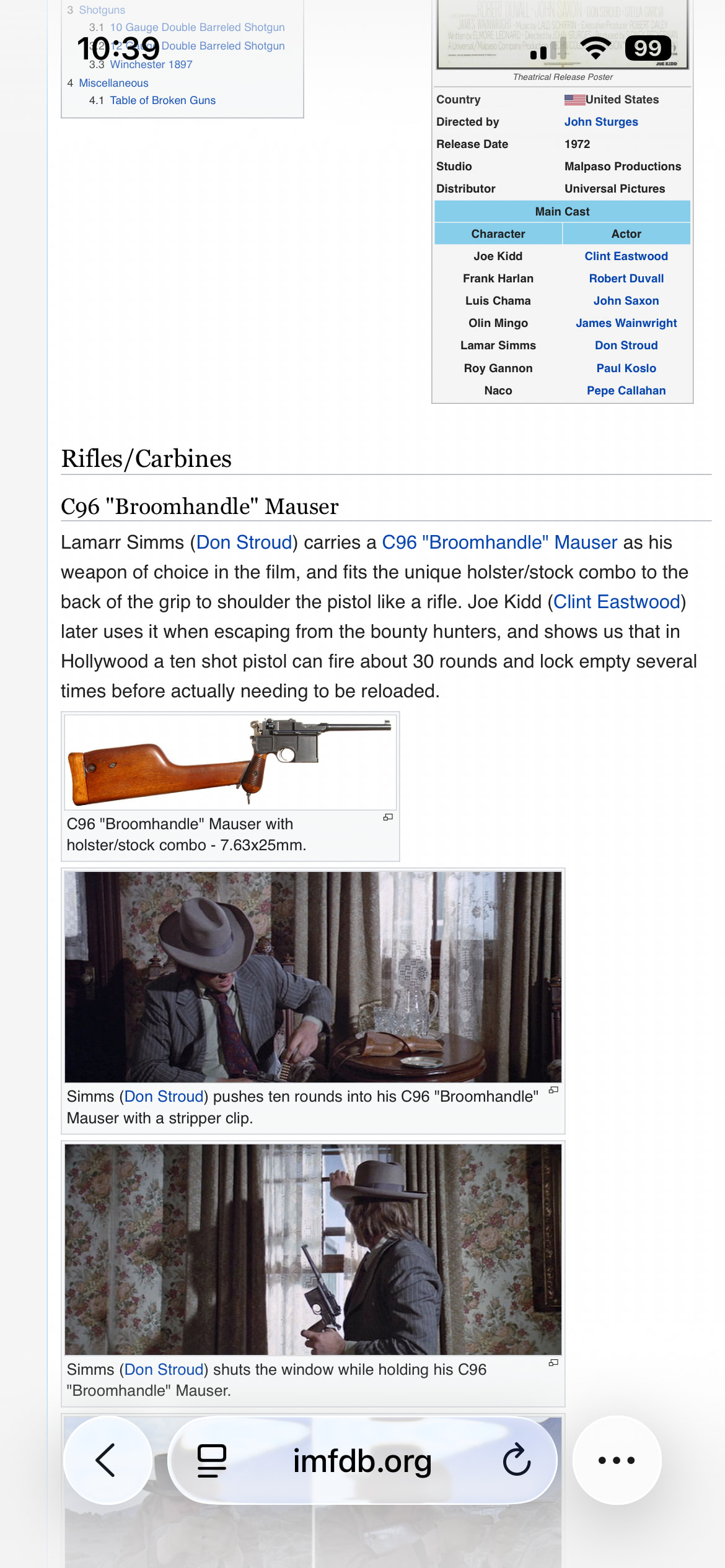
Clint wears a similar hat in Joe Kidd and he has the same pistol that Silence had, a Mauser C96.
Don Stroud has the Mauser (another Cox error) with a long-handled attachment like Van Cleef has in For a Few Dollars More. Clint uses it at one point but soon trades it back for his Colt SAR.
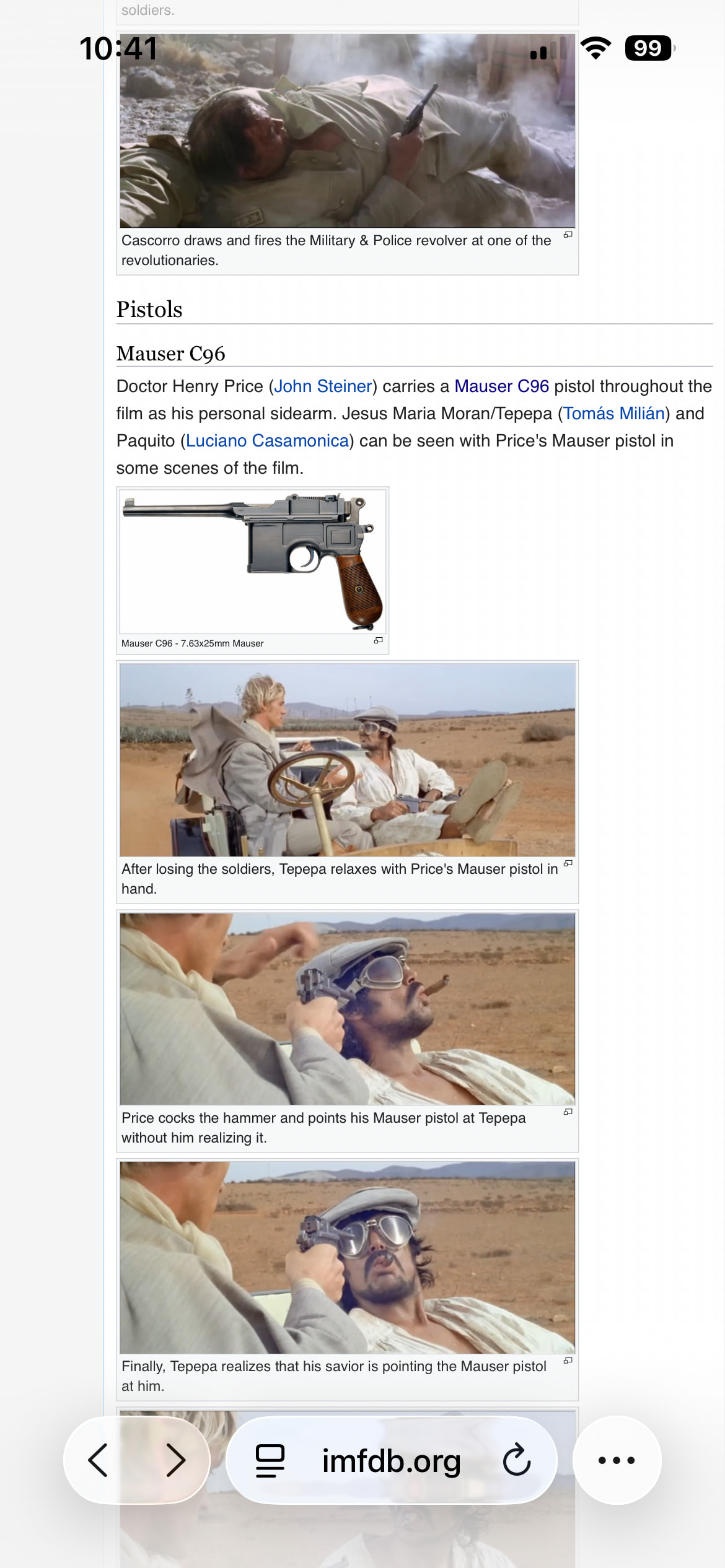
John Steiner also carried a Mauser in Tepepa (probably the same one used by Silence) but no-one claims Tepepa is a remake of The Great Silence.
But yes - a hat and a gun ‘proves’ it is a remake of The Great Silence
The Internet movie Firearms database is a good source for weapons info.