Ahab dies for the whale. The boat is only a means to an end.
The captain in Das Boot is mostly a very calm and very reasonable man, a kind father figure. Ahab is feared by his crew, a wrathful father.
Ahab dies for the whale. The boat is only a means to an end.
The captain in Das Boot is mostly a very calm and very reasonable man, a kind father figure. Ahab is feared by his crew, a wrathful father.
[quote=“Stanton, post:8681, topic:1923”]Ahab dies for the whale. The boat is only a means to an end.
The captain in Das Boot is mostly a very calm and very reasonable man, a kind father figure. Ahab is feared by his crew, a wrathful father.[/quote]
It’s not really the character, it’s the place of the character within the story, and the way it functions. What Ahab is chasing, is mainly the image of Moby Dick in his head, not the whale itself. The whale is only a huge animal, representing, above all, the sea, the immense open (Melville thinks it’s a fish, he doesn’t believe it’s a mammal), what makes the image, or this fish, frightning, is the power it has over Ahab. The fish (whale) did not intentionally hurt Ahab, that’s what Ahab makes of it, Arab himself was guilty, he only personalises the animal to excuse himself, and he cannot revoke this idea, because it would imply that he himself was guilty from the beginning. What his people fear, is not really the man, but the fact that might not be able to beat the sea, the whale, or revoke this idea in his head (and turn around) so the adventure will lead to their death. They are afraid of dying, of not surviving the adventure. That idea is also very strong in Das Boot, at least I saw it that way: every time the boat is in danger, and the captain commands to go deeper and deeper, you hear the boat ‘cry’. And the war reporter has the same function as the Ismael character, we see things through his eyes, the narrative is a report. Ismael is the only one who survives, he’s also nameless (Call me Ismael, not My name is, or I am called) and some think the story of Moby Dick is not the real story, but a reflection of Ismael’s personal fears. He was under the spell of the fantasies about the immense creature too, and only the death and destruction of all things, men and beast, could liberate him.
I watched Hunde, wollt ihr ewig leben, yesterday night, and the General Paulus character is presented in exactly this way: he’s not a bad man per se, but he can’t ignore the orders he has been given, even when realizes that they will lead to the death of the man under his command. Like Ahab, he cannot ‘revoke’ his decision to follow orders: it would mean he was wrong himself right from the start. That is what this Ahab idea is about: not being able to make a rational judgement, following an idea even if it inevitably leads to your own death and destruction.
I think that while Das Boot was clearly inspired in its narrative by Moby Dick as well as the character of the reporter plainly a stand-in for Ishmael. However, the Captain is pretty different to Ahab even if his role has certain similarities. His personality is more pleasant and the makers obviously want you to sympathise with him, unlike Melville where Ahab operates as the true “villain” of the novel. Movies like John Ford’s The Searchers (1956) and Sam Peckinpah’s Major Dundee (1964) both follow the tale of the whale more closely and the characters fitting into the established roles more easily. In fact, many a film that derives around an obsessive quest find themselves modelling the plot in some way on Moby Dick as its a rich conceit that allows you to hang a lot of disparate events onto a strong storyline that is always building towards a climax and a resolution, always moving forward. One of the flaws in Peckinpah’s Major Dundee is that towards the end the raison d’étre is changed and thus lessens the impact of the climax.
I think that has to do with context. Moby Dick is set on a boat, during the time of whaling and the great maritime nations, and Ahab’s men are trapped (they can’t escape from the madman and the boat) by the very severe system they’re part of: mutiny was punished in most countries by the death penalty. Many sea stories are about that conflict: the crew knows things are going wrong, but mutiny is very big risk, and will make them wanted men forever (mutineers usually became pirates or smugglers, or both). In this context, the author needed a madman for the captain, otherwise the problem would have been solved. A sympathetic captain would’ve said: Okay guys, I was wrong, sorry, we call it a day. Story over. In Das Boot this ‘system’ is the nazi party, their decision to go to war and the captain’s decision to be a part of it. Once he’s into it, he can’t escape: he has to fight for his life. It’s what sometimes is called the soldier’s trap: once you are fighting in a war, you must continue fighting. In this sitation, there’s a posiibility to depict the leader, the captain, in a more human, more sympathetic way. A mutiny in Moby Dick, would imply a mutiny against the captain, only indirectly against the system, a revolt in Das Boot is directly a revolt against the system.
These things happen very often when a story is trasferred to another time and space: Leone had trouble with the idea of the No Name character saving the Holy Family because it’s a strange thing to do for a man like him, while Japanese audiences expected it from the wandering samurai. I’m studying Stagecoach at the moment: it’s an adaptation of a Maupassant novella, Boule de Suif, but some elements have been changed, with some unexpected results, probably overlooked by Ford himself.
[url]http://imageshack.us/photo/my-images/607/hundewolltihrewigleben1.jpg/[/url] Hunde, wollt ihr ewig leben (Frank Wisbar, 1959)
An early movie about the battle of Stalingrad, presenting the historic event in almost documentary fashion. It starts with stock material of marching soldiers, a voice-over explaining how impressive the look and sound of marching soldiers may be, but warning us at the same time for the gruesome reality behind the very idea. We are then, all of a sudden, confronted with dead soldiers, buried in the snowy Russian steppe.
A young lieutenant called Wisse is sent to Stalingrad to serve as a liaison officer, but soon after his arrival, the German troops are encircled by the Red Army. The Germans are trapped and the only possibility to escape from this hopeless position, is a breakout, but Hitler orders the German soldiers to fight until their last breath. Their leader, Paulus, knows things will inevitably go wrong, but he’s trained to follow orders, and when he finally decides to ignore them, it’s already too late.
No doubt this movie was a major source of inspiration for Vilsmaier’s Stalingrad (1993) - Vilsmaier copied various scenes - but the atmosphere is decidedly different. There’s more hope left here, and the German command is presented in a much more positive way. Apart from Hitler and the hesitant Paulus, only Wisse’s direct superior, Major Linkman, is shown as arrogant and (eventually) as a coward (he wants to surrender but is shot by his own men). The movie lacks rational and emotional distance, but it’s still a quite powerful cinematographic document, made in a period when the German nation was trying to redefine its own history and find a new identity.
The movie was shot in Germany itself, using a lot of stock material for the action scenes. As a result, it looks far less realistic than Vilsmaier’s movie, but that’s all excusable. Performances are excellent, and as usual in a movie with clichéd characters, it’s the actor who plays the bad guy (Wolfgang Preis) who makes the best impression. You’d almost sympathize with his coward of a Major Linkmann.
The title, Dogs, Do you want to live forever, refers to a line allegedly spoken by Frederick the great during one of his famous battles.
I’m not sure if saving Maria is such a strange thing for the Man with No Name. I find that the theory that he is a hard, cold bastard doesn’t work completely. Unlike with other Spaghetti Western heroes, he does (occasionally) help others, like during the Civil War battle sequence in The Good, the Bad and the Ugly. Perhaps its an American influence on Leone, or maybe he was just continuing the character he had heavily based on Yojimbo.
The similarities between Stagecoach and Boule de Suif are plentiful, but the movie goes off in another direction with the introduction of John Wayne’s Ringo Kid. Ultimately, John Ford was only using the novella as a basis or inspiration for his film while Sergio Leone lifted Yojimbo and placed it in a Western setting in A Fistful of Dollars, so the connection is more evident and tenuous.
[size=12pt]Fuga dal paradiso [/size] -1990- Ettore Pasculli
Still on my my P.A. watch run. Actually not a bad film, not the usual more exploitive Italian P.A. like films Escape from the Bronx and derivates, the message and the heros are definetively different.
Also the cast, we got Horst Buchholtz, Jacques Perrin, Aurore Clement, a young Ines Satre even Lou castel, only the main hero the young Theo, was played by an unknow actor to me, so a very quality cast, not Mark Gregory.
The story is quite simple trying to deal with what the director must thought were or going to be the troubles that would condemn today’s societies in the future , got elements from very different sci-fi films from Stalker to a Boy and his dog, even star wars among others.
In the end a good film and not dated IMO, with a strong ecological message and not only.
Good score form Michael Legrand, perhaps this was made with the intention of achieving more boxoffice success, but until a few days ago, I’ve never heard of the film before.
never heard of this - already added to a watch pile - i’m going for some PA run too in the near future
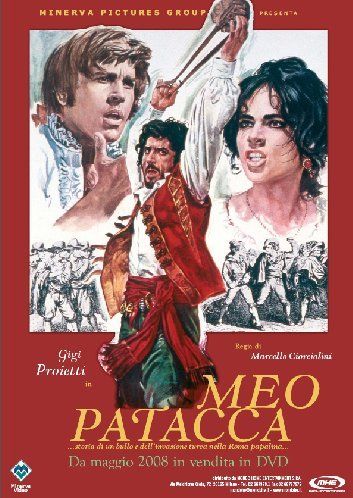
[B]Meo Patacca[/B] - Watched it this evening. Meo Patacca is like some sort of phony hero who somehow gets convinced by a group of Romans to attack some conquering Turks. But he doesn’t quite do what they think he’s done. OK for a watch but nothing special.
The Appointment (1981).
Edward Woodward plays a business type of guy who goes on a trip in a rented car. From then we have bags of atmosphere in this supernatural thriller. The camerawork and the scenery create a spooky atmosphere, and its a bit like Duel in parts. You know something is going to happen which does keep you on your edge of your seat, but you do not know when… Unknown film to me till recently and well worth a look.
[quote=“ENNIOO, post:8690, topic:1923”]The Appointment (1981).
Edward Woodward plays a business type of guy who goes on a trip in a rented car. From then we have bags of atmosphere in this supernatural thriller. The camerawork and the scenery create a spooky atmosphere, and its a bit like Duel in parts. You know something is going to happen which does keep you on your edge of your seat, but you do not know when… Unknown film to me till recently and well worth a look.[/quote]
Yes, it is. I think he accidentally killed his family and himself at the recital, 3-years earlier… drunk-driving.
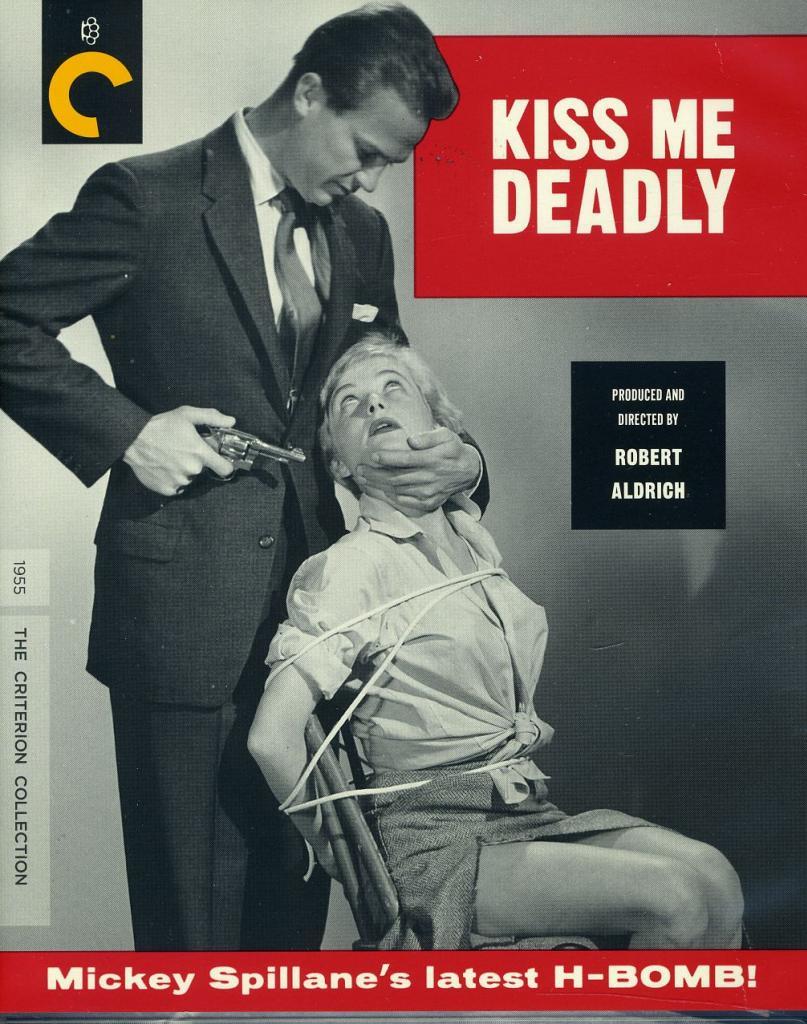
Kiss Me Deadly - Enjoyed this, the main character Mike Hammer is a bit of a swine in this one, no problem is smacking women about and shutting an elderly doctor’s fingers in a drawer.
The Big Bounce - Ryan O’Neal plays an ex-delinquent who meets up with (his then wife) Leigh Taylor-Young. She gets a kick out of committing petty crimes, fun till they get bigger and it ends up in murder. OK for a watch but I wouldn’t revisit in a hurry.

[url]http://imageshack.us/photo/my-images/96/11166568det1.jpg/[/url] [size=12pt]Bait 3d [/size] (K. Randell, 2012)
I watched it in 2D, normally not a problem (I prefer 2D to 3D), but the 3D-effect are so agressive that even in 2D they work disorienting. Sharks jumping out of the water in the direction of the viewer, body parts floating in front of the camera like the space ships in 2001, etcetera etcetera.
The movie itself is supposed to be a mindless gore fest, and it that aspect it delivers - occasionally. The sharks look good but I guess the effects were quite expensive, because it takes a while before the sharks start doing what they’re supposed to do, and even then there aren’t too many scenes with them. The director shows some sense of humor, which helps. Unlike the other recent shark movie, The Reef, this movie can’t be taken seriously.
Mindless fun it is, the thing I needed after my Chinese class
6/10
The Alpha Caper, 1973… Henry Fonda, as a parole-officer and security-consultant who masterminds a foolproof armored-car robbery using parolees: Larry Hagman, James McEachin, and Leonard Nimoy who’re experts in their fields. Logically played and strategized. The music-score backs off, and lets the scenes play-out in their own tension. The best scene is when a surveillance-cam malfunctions as the route for the armored-cars is about to be revealed. Fonda has to troubleshoot the cam via radio-instructions while the route-conversation approaches its climax. Very good heist-film.
[size=12pt]The Island [/size] - 1980 - Michael Ritchie
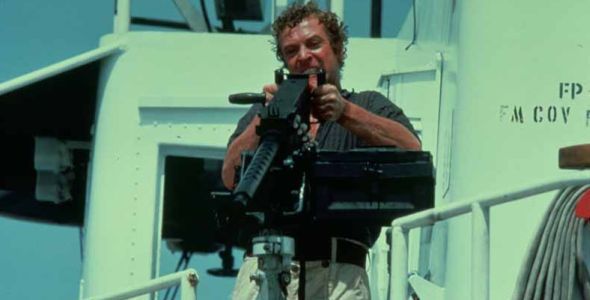
Michael Caine a la Wild Bunch mode
Actually this is a bad movie, inept script, with a very implausible to say the least story, lot’s of violent scenes most totally unnecessary, a cheap feeeling, but helas it was fun to watch. Without being a funny film, it can be considered one of those cases that its so bad its funny, and the word funny here to be is honest a bit out of place.
Michael Caine who also must have done this to spend some days in the Caribbean Islands, is ok as David Warner the terrific pirate leader, but the film is so strange that it’s hard to classify, doesn’t have a serie B or Z feeling (maybe cause it got Caine and Warner), I only know its bad.
Michael is a reporter that travels to the Bermuda triangle region to investigate the misterious disappearance of some boats, takes is son along to spend some quality time together , since his divorce. But all hell brakes loose when they are kidnaped by modern day (but old in style) pirates, that in just two days brainwash Caine’s son to became one of them hell yeah.
The last scene for someone who was in the Navy is like…well… you have to watch it
Bad true, but does have Caine and a lot of blood/gore and violence with some nasty scenes and most important I believe Sartana1986 seal of approval
Inglorious Basterds (2009) by Quentin Tarantino for the first time.
One word: in-fucking-credible, as Quentin would put it. Simply wonderful piece of cinema. It lasts 2 and half an hour, but it doesn’t feel long at all, as the time passes unbelievably swiftly. The rendition is perfect, the flick consists of some portentous scenes, particularly bar scene was imposingly made, just pure delight. The tension is incomparable to anything in that moment, even though the scene is long it never feels too long. The way Quentin creates the suspense reminds me a bit Leone who utilizes languorous scenes of anticipating what is going to transpire next before the explosion of unbridled violence. As regards acting, Christopher Waltz is phenomenal, this guy knows how to act properly and he gives a terrific performance. However, Brad Pitt is the main star of the film for me. His Italian and “buon giorno” must be the most hilarious things I’ve ever heard in my life. The rest of the cast is of course great as well, but these two actors makes it so funny and entertaining. The whole concept of combining two exploitation genres: macaroni combat and spaghetti western is certainly weird, but… this is Tarantino. And this bizarre combination is perfect. Absolutely breathtaking. Pure entertainment. Loved every minute of it. 9/10
I saw Steven Spielberg’s Close Encounters of the Third Kind (1977) in the Collector’s Edition Cut yesterday. It’s a splendid film, the human drama never getting lost in amidst the superb special effects. Here, there is no X-Files style paranoira with the meeting of alien and man or Independence Day-esque alien baddies or even raging army colonels wanting to kick E.T.'s arse; Spielberg here gracefully stage manages the most benign possible meeting and it works from a dramatic point of view. In lesser hands it could have lacked excitment, but here, Richard Dreyfuss’s and Melinda Dillon’s quest to reach Devil’s Tower in Wyoming to make sense of their own personal “Close Enocunter” is thrilling. It also, thankfully, never lays on the sentiment: Dreyfuss never reunites with his family here, driving them away with his obessive behaviour. The iconic music score by John Williams will have you humming it all day and the photography was a deserved Oscar winner (for Vilmos Zsigmond; additional photography by Laszlo Kovaks, William A. Fraker and Douglas Slocomb no less!) as was its Academy Award for sound.
Shark Night (2012) - No fun at all, takes itself way too seriously… the complete opposite of Snakes on a Plane (from the same director)
Yep. Just watched it. Was suspicious of that middle-aged UK-chick who sped-off in her van, without explanation.
[quote=“Mickey13, post:8696, topic:1923”]Inglorious Basterds (2009) by Quentin Tarantino for the first time.
One word: in-fucking-credible, as Quentin would put it.[/quote]
Yeah, it’s a good one - just a guess, but that last scene of Pitt saying “This is my masterpiece” always struck me as Tarantino saying that to the audience…
![http://imageshack.us/photo/my-images/607/hundewolltihrewigleben1.jpg/[/url]](http://imageshack.us/photo/my-images/607/hundewolltihrewigleben1.jpg/%5B/url%5D)
![http://imageshack.us/photo/my-images/96/11166568det1.jpg/[/url]](http://imageshack.us/photo/my-images/96/11166568det1.jpg/%5B/url%5D)