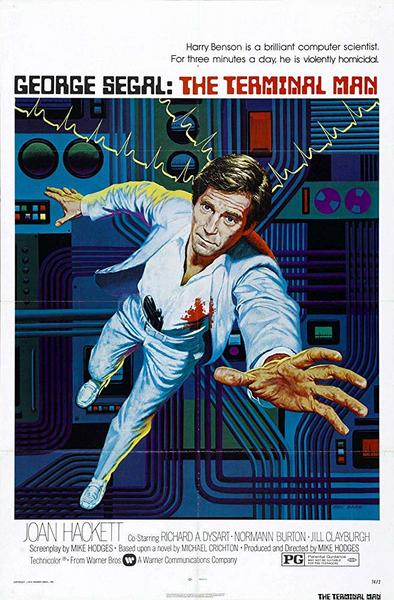
I read this book by Micheal Crichton as a kid and loved it then - I’m surprised I didn’t track this movie down yet - or maybe I did and forgot about it. I didn’t have much appreciation for these slow burners as a youngster.
The story is about some scientists/doctors that implant electrodes into a man’s brain to control his mental problems through electrical impulses. Crichton is one of those scifi writers that was way ahead of his time, and this is a story that is very relevant to modern times as current scientific research is experimenting with doing just this kind of thing in various ways, direct attempts at manipulating brain functions with technology, including electrical stimulation.
I hate to quote a source as commonplace as wikipedia, but this bit is great info on the film:
The Terminal Man, though not released in the UK, was successful in Japan and, according to Hodges, it was dumped when it came to US screenings. "We had one terrible preview. They projected it without sound for the first 10 minutes, which was excruciating. American audiences found the film too uncompromising, too tough to take. The reviews were dire. "I think people had a problem accepting George Segal in the lead role. At that time he was known as a light comedian, but I wanted him for the film. I liked the fact that it was unusual casting. He is terribly good in it and, now that his career is not too top heavy with comedy, you can see him purely as an actor - and a good one.” [4]
Nora Sayre gave the film a negative review in The New York Times , describing it as dull and slow: “George Segal’s resilience, humor, and versatility have redeemed quite a few bad scripts. But this role gives him little chance to act, beyond making like a Zombie and rolling his eyeballs back…”[5]
Stanley Kubrick was also a Hodges’ admirer — “Any actor who sees Get Carter will want to work with him.”
When Mike Kaplan, a Warner Bros international marketing executive, attempted to override Warner Bros decision not to release the film in Britain, he sought Kubrick’s help. After explaining the situation, and how the film required a different marketing campaign, Kubrick interrupted with, “I’ve already seen it and it’s terrific.”
The director Terrence Malick wrote to Hodges expressing how much he loved watching The Terminal Man , saying “I have just come from seeing “The Terminal Man” and want you to know what a magnificent, overwhelming picture it is. You achieve moods that I’ve never experienced in the movies before, though it’s only in hope of finding them that I keep going. Your images make me understand what an image is, not a pretty picture but something that should pierce on through like an arrow and speak in a language all its own.”
I can certainly see why Kubrick would appreciate the film, as at times it is very similar to Kubrick’s style & shares some themes explored in Kubrick’s works.
As a plus, the film features Glenn Gould’s Goldberg Variations, which I consider maybe the best piano renditions of Bach I’ve ever heard.
 LOL … long live trash! - plus, stick to what you enjoy, not what Hollywood dictates.