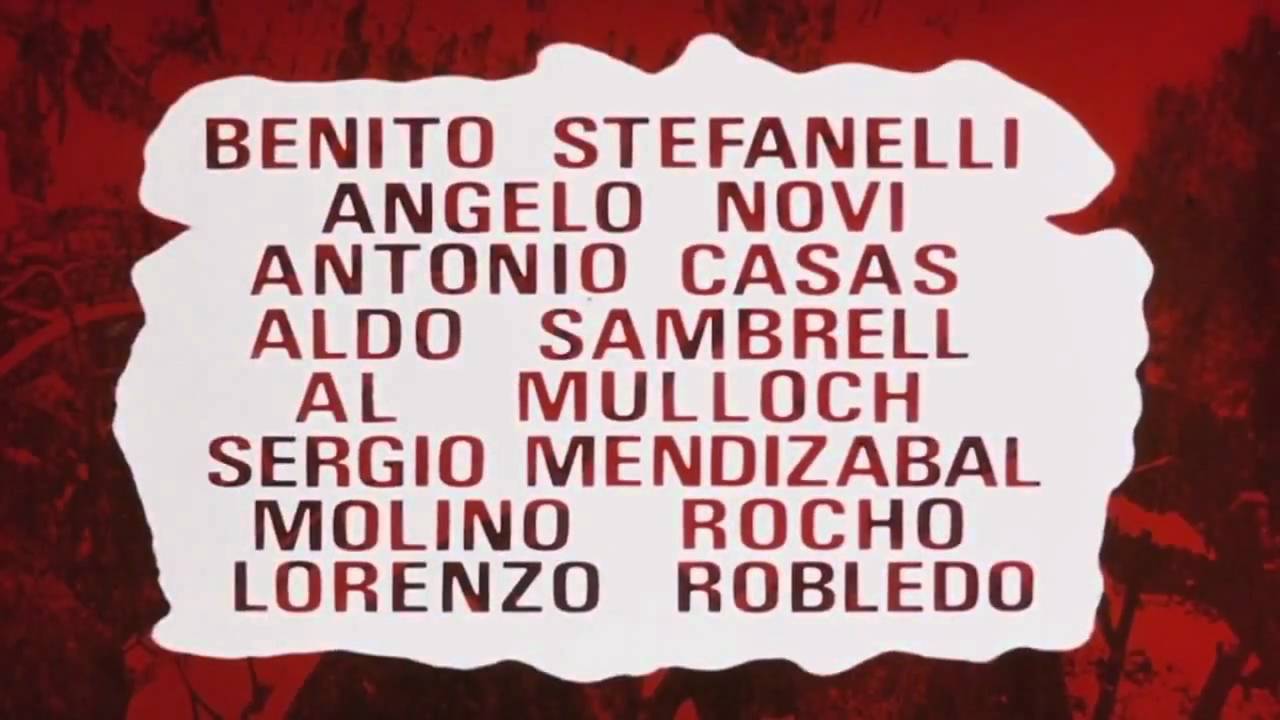
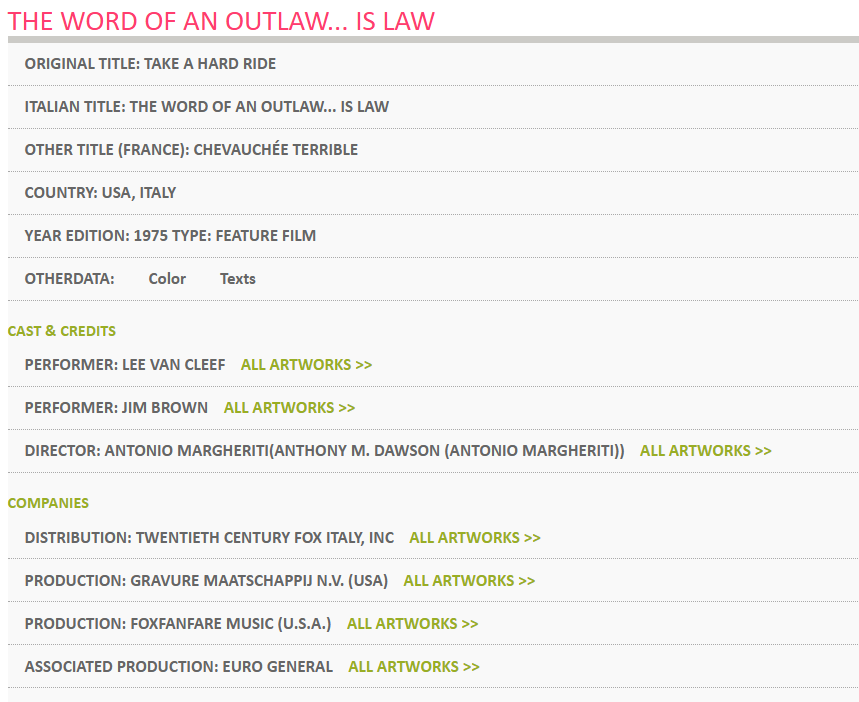
Yes, baffling. But the fact that only four Italians (and no Italian actors at all) were involved in the making of Take a Hard Ride – Margheriti, his cinematographer Riccardo Pallottini and, judging by the names, camera operator Carlo Tafani and special effects supervisor Luciano D’Achille – makes the participation of an Italian production company unlikely, I think.
Fantastic!
Yes, of course. But we need the correct countries of origin for the database.
But the beginning of this discussion was that it was put in the Eurowestern and hybrids section, but coming from an Italian director should be reason enough to put it back to the “real” SWs.
The Italians?
As in most sources the film is listed as Italy/USA production, we should just leave it at that.
Btw Paramount is not listed as co-producer in the credits for OuTW despite giving most if not all of the money.
But then, OUtW is officially a sole Italian film.
but the Italians who? a person, or a company? in any case, who. I just wanna know, I am not generally saying it’s not an Italian co-production, but if it is supposed to be, then for us nerds it would be great to know in howfar
we can do that, just a short matter of copy and paste, we just need to put something like [[Category:United Artists]] at the bottom of each movie entry that applies
Giusti lists Euro General (Roma) as the Italian co-producers in his Dizzionario. But to complicate things further, the film is not included in the Catalogo generale dei film italiani for 1975. So, it would seem not to be considered Italian enough by A.G.I.S
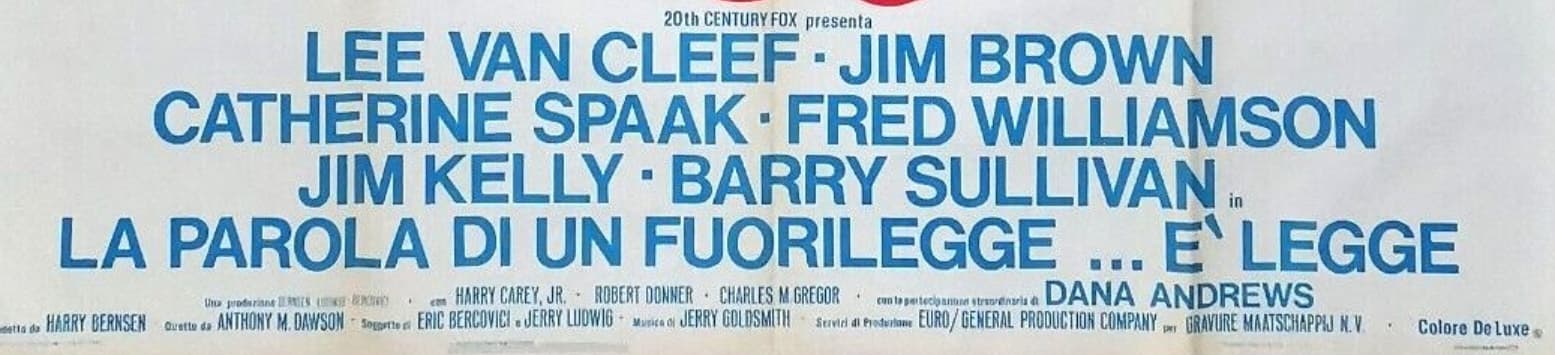
The above is consistent with the Italian poster which has ‘TCF presents’ and credits the two companies above. So TCF Italy distributed it in Italy and it was a co-production between the two companies above which appear to bean Italian and USA company (although NV is not a USA company name).
Just saw this for the first time. It was better than I expected given its rep especially the first half which was just one shoot out after another. But then it started introducing characters who were almost immediately killed and had two ludicrous WTF scenes that should never have been included. I was surprised Catherine Spaak was bumped off so early. Jim Kelly had a weird role as the mute kung fu expert but then I guess they were hedging the Kung Fu bets as well; I think he was wearing a Billy Jack hat also. That secondary pair of black guys seemed to exist only because they wanted to make a joke that all black people look alike to whites. Ronald Howard is introduced as this Jack Palance-like mad Confederate but dies about 5m later. I also noticed that great play was made of our heroes negotiating a rope bridge (which they destroy after crossing ) but then they get overtaken by Van Cleef’s mob soon afterwards who must have been the other side of the bridge originally. Same happened with that ravine the wagon flew over. Goldsmith’s score, which has come in for criticism on this forum, is similar to the one he did for Bandolero (1968) and his latter Breakheart Pass (1976) as well. Lots of close-ups and some low angles do make this like a spaghetti western but some of the story telling isn’t- for example the unnecessarily long backstory given to the Spaak character (in Four of the Apocalypse, Lynn Frederick’s similar backstory is dealt with in a couple of elliptical sentences which make the point but don’t use up minutes of screen time).