Navajo Joe (Sergio Corbucci, 1966
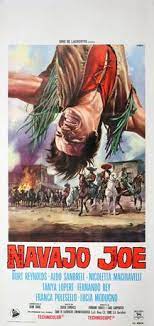
We all know what Burt Reynolds himself thought of this film (for most of his life) so let’s just state that if you think this is crap, or at least one of the lesser films of the genre, you haven’t seen many SW:s. Navajo Joe is actually a far, far above average Spaghetti Western both in terms of production value and premise, although it’s admittedly the style and slightly off-beat themes rather than some kind of cinematic greatness that make this film a personal favorite of mine.
In most westerns, there are two ways to portray Native Americans - as mindless savages (thankfully chiefly in older pictures) and more recently as innocent victims of colonization and imperialism who can’t defend themselves. The latter is by all means objectively true (the story of the Native American genocide reveals horrors by Holocaust proportions, albeit not quite as industrially systematical), but it often ends up stating “these poor native’s couldn’t stand up”, which could also be seen as slightly offensive (although in a more benevolent way than the “savages” portrayals). In Spaghetti land, this is generally irrelevant because Native Americans hardly show up at all, and when they do - like in Sabata, The Return of Ringo or briefly in The Hellbenders, the depiction is generally quite unconvincing. The most convincing depictions of Natives actually tend to be those were they have some part in the plot, but are only mentioned (like in Fistful of Dollars).
Here, however, we have a Navajo hero who is not a fantasy warrior nor a pitiful savage - just a generally pissed off farmer who happens to be good with a rifle, and to be at the wrong place at the right time. It’s most prominently discussed during his famous speech about who’s the actual American of him and the Esperanza sheriff, to demonstrate that his more of a true American by blood than any of the nativist townsfolk.
Don’t get me wrong here, this film is certainly not an attempt to depict Native Americans in an authentic way, but the navajos are correctly depicted as peaceful farmers (although no, they did not live in tipis), and the scalphunting part was indeed a thing during the purges of Navajo tribes in the mid-19th century, while Morricone’s score is claimed (from an unreliable source) to be based on a traditional Navajo hymn. And what a score! It’s maybe his wildest western compositions up until that point, with Native American shouting, blues-rock-style electric guitars and the choir bursting “Navajo Joe, Navajo Joe”.
As usual for Corbucci, there’s plenty of positive female portrayals. Aside from Estella, we have Mrs Lynne, who is probably the most open-minded citizen of Esperanza along with Father Parson, as well as the showgirls, who are nowhere as pappy as they may seem at first sight. It’s a shame two of these characters fail to make it to the “The End” mark of the film.
And that’s maybe the main shortcoming here. I recall reading a reviewer who felt that the seriousness of the concept “taking a persons life” felt a bit watered down in this film, and I have to agree. Several supporting characters are killed off for no real reason other than adding some extra brutality. I would much rather have seen those few minutes spent on further development of the racism themes of the film.
But it doesn’t matter too much. Navajo Joe is a highly entertaining spaghetti western, one of the finest in the genre.
The grade? From a strictly cinematic viewpoint, 7/10 would be a proper score. But the music, entertainment value and concept is just about enough to give it an extra star. 8/10
(It seems like I will not write my next and final review until after midnight. But on the other hand, that would give me the honor to end the 2022 Spagvember fest, in which university homework of inhuman proportions have hindered most of my participation. That is, if the admins allow me to do so).


 Well, shit! I did that twice. It’s been a long month. Or maybe I thought they were in Spain. I don’t know.
 .
.